Amla powder hair before and after, what you can really expect
With amla powder, the before-and-after is first visible in the shine and feel, often after the very first mask. The rest—a stronger hair fiber, hair that looks thicker and fuller, and more volume—develops gradually over several weeks of regular masks. It’s not a one-time miracle; it’s a treatment that builds up over time.
If you search for “amla powder hair before and after,” you’ve probably seen some impressive photos on social media. Here is what you can reasonably expect from this plant, how often to use it, and how to judge the changes in your own hair.
Contents
- Amla powder hair before and after: what really happens?
- What do you notice after the first mask?
- How long does it take to see a real before-and-after?
- How to create your own before-and-after?
- Why do some people see no results with amla?
- How to use amla for better results?
- In summary
- Frequently asked questions
Amla powder hair before and after: what really happens?
Amla is an Indian fruit that has been used in traditional hair care for centuries. Dried and ground into a powder, it is rich in tannins and antioxidants. Its known uses are to strengthen the hair fiber, revive shine, and purify the scalp. We have already introduced the plant in detail in our article on amla for hair. Here, we are focusing mainly on results and patience.
One important thing to keep in mind. Amla works on the appearance and feel of your hair, not its nature. Straight hair will not become curly, and severely damaged hair will not become new again after one mask. What amla brings is a better-coated, shinier, and more manageable hair fiber.
What do you notice after the first mask?
This is the most surprising moment. After rinsing and shampooing, you often notice three things right away.
More visible shine
Like many acidic plants, amla helps smooth the hair cuticle. Light reflects better, and the lengths look shinier, especially on dark hair.
A thicker feel
Tannins have a slightly coating effect. To the touch, the hair feels firmer and a little thicker, giving it more substance.
Roots that can breathe
The scalp feels fresh and clean, and the roots fall flat less quickly. This is often where you feel the first gain in volume.
These effects are real, but they are related to the treatment of the day. If you stop after one mask, they fade away with each wash.
How long does it take to see a real before-and-after?
With plants, consistency makes the difference. One mask per week for at least one month is a good starting point to begin judging. Here is, in general, how things evolve.
The first 2 to 4 weeks
You get into the rhythm and learn how to mix the paste. The hair is shinier and easier to comb through after each mask, and you start to feel a stronger fiber when detangling.
Between 1 and 3 months
This is generally the period when the before-and-after becomes noticeable. The effects no longer disappear from one wash to the next, the hair looks thicker and fuller, and the lengths have a more even appearance.
Beyond 3 months
The mask becomes a real maintenance ritual. You are no longer looking for a dramatic change; you are keeping your hair in good shape week after week.
These stages are indicative. Every head of hair reacts differently depending on its nature, its starting condition, and your routine.
How to create your own before-and-after?
Rather than relying on other people's photos, the most telling thing is to follow your own hair. A few simple tips allow you to have an honest comparison.
- Take a photo before your first mask, then one every four weeks.
- Always use the same lighting, ideally near a window during the day, and the same angle.
- Photograph your clean hair styled the same way, loose and without styling products.
- Also note your sensations: ease of detangling, volume hold, and the feel of the ends.
A small photo in different lighting can give a false impression, one way or the other. With these guidelines, you will see what has really changed.
Why do some people see no results with amla?
When the before-and-after is disappointing, it is often a question of method rather than the plant.
Using the powder alone
Alone and without oil, amla powder can leave some hair feeling a bit rough, especially if it is already dry. It is therefore traditionally combined with gentler plants and a little oil.
Too short or too long a leave-in time
Twenty to thirty minutes are enough. Less than that, and the treatment does not have time to work. Much longer, and the paste becomes difficult to rinse out without adding anything extra.
Incomplete rinsing
Powder residue dulls the hair. Rinse thoroughly with water, then do your usual shampoo.
Lack of consistency
A mask now and then gives a nice effect on the day, but not a real before-and-after. It is the weekly repetition that counts.
How to use amla for better results?
In Ayurvedic tradition, amla is almost always combined with other plants. This is the idea behind the Ayurvedic Ritual Mask, which combines amla with marshmallow root, brahmi, bhringraj, kapoor kachli, shikakai, and reetha. Marshmallow makes the paste creamier, shikakai and reetha cleanse gently, and the whole combination adds volume, strengthens the fiber, and purifies the scalp without drying out the hair.
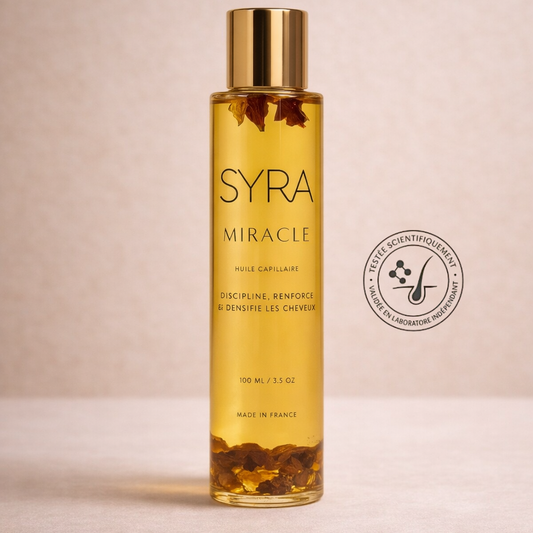
To use it, mix 2 to 3 tablespoons of powder with warm water until you get a paste, then add 1 tablespoon of Miracle Oil. Apply to the scalp and lengths, leave on for 20 to 30 minutes, then rinse and shampoo. During the leave-in time, the paste dries out a little; this is normal. If you are new to powders, our Ayurvedic powder guide details each step.
To go further, you can do your oil treatment a few hours before and apply the mask on top. The oil protects the lengths, and the paste spreads more easily.
In summary
With amla powder, the first effects are visible after the first mask, especially in shine and feel. For a real before-and-after, allow at least one month of regular masks, one mask per week. Between one and three months, the hair looks thicker and fuller, and the effects no longer fade from one wash to the next. For good results, combine amla with gentler plants and a little oil, leave on for 20 to 30 minutes, and rinse thoroughly. To judge honestly, take your own photos every four weeks, in the same lighting.
Frequently asked questions
How many amla masks per week?
One mask per week is suitable for most hair. On very dry hair, you can space it out to once every ten days.
Does amla darken the hair?
Used alone as a mask, amla does not color the hair. It can simply revive the shine of a dark natural color.
Should you stop using amla once you have achieved results?
No, you can continue at your own pace, with one mask per week or every fifteen days to maintain shine and volume.
Can amla powder be used on fine hair?
Yes. Amla has a slightly coating effect that gives fine hair more substance. Combined with gentle plants and a little oil, as in the Ritual Mask, it adds volume without drying out.
Should amla powder be applied to dry or wet hair?
It is easiest to apply it to slightly damp hair, or directly over an oil treatment. The paste spreads more easily, and you cover the scalp and lengths better.
Why is my hair rough after an amla mask?
It is often because the powder was used alone, without oil, or because the leave-in time was too long. Add one tablespoon of oil to the paste, leave on for 20 to 30 minutes, and rinse thoroughly before shampooing.
Can the amla paste be prepared in advance?
It is better to prepare it just before application. A fresh paste spreads better and rinses out more easily.
If you want to create your own before-and-after with amla, the Ayurvedic Ritual Mask combines amla and six complementary plants for you in a single sachet. A little warm water, one tablespoon of Miracle Oil, and a weekly appointment—that is all it takes to see your hair change over the weeks.