Amla for hair: what are the benefits and how do you use it?
Amla for hair is one of the great classics of Indian tradition. This small green fruit, rich in vitamin C and antioxidants, has been used for generations to strengthen the hair fiber, revive shine, and purify the scalp. It is mainly used as a powder in a mask, or as amla oil to massage the scalp.
If you are looking for information on amla for hair, it is probably because you have heard of it without knowing exactly what to do with it. Here is what you need to know about this plant, how to use it practically, and what you can expect.
Table of Contents
- What is amla?
- What are the benefits of amla for hair?
- How to use amla on hair?
- Amla for hair, how often to use it?
- Why combine amla with other plants?
- In summary
- Frequently Asked Questions
What is amla?
Amla, also known as Indian gooseberry (Phyllanthus emblica), is the fruit of a tree grown in India and much of South Asia. It looks like a small pale green plum and has a very sour taste. In India, it is eaten fresh, preserved, or as chutney, and it holds a special place in Ayurveda, the great Indian tradition of well-being, where it is considered a precious fruit.
For hair, the dried fruit is used and then ground into a fine powder. This is the powder found in Ayurvedic masks, either alone or mixed with other plants.
What are the benefits of amla for hair?
Amla is known for its natural richness in vitamin C, tannins, and antioxidants. This is what explains its place in Indian hair rituals for centuries. Here are the traditional uses attributed to it.
Stronger fiber
Traditionally, amla is used to strengthen hair. The tannins it contains have a slightly coating effect on the fiber, which makes hair look thicker and feel more resistant to the touch.
Shine and radiance
Like many acidic plants, amla helps smooth the hair cuticle. As a result, light reflects better and hair looks shinier after rinsing.
Purified scalp
Applied as a mask, amla is also used to purify the scalp and give it a fresh feeling. It is a good way to take care of the roots, where it all begins.
And the color?
In India, amla is often associated with dark hair and is sometimes added to henna to soften its reflection. Used alone as a mask, it does not color the hair. It can simply revive the shine of a dark natural color.
How to use amla on hair?
There are two main ways to enjoy amla. The powder in a mask, which is the most common, and amla oil, which is the traditional use for massage.
Amla powder in a mask
The method is simple. You mix the powder with warm water until you get a smooth paste, neither too liquid nor too thick. You apply it to the scalp then to the lengths, leave it on for about twenty minutes, then rinse thoroughly before shampooing.
Used alone, amla powder can feel a bit drying on some hair, especially if it is already dehydrated. This is why it is almost always combined with gentler plants and a little oil. If you are new to powders, our Ayurvedic powder guide details all the steps, from dosage to rinsing.
Amla oil, the traditional use
Amla oil is not an oil pressed from the fruit. Traditionally, dried amla is macerated in a vegetable oil, very often coconut oil, for several days or by heating it gently. The oil then absorbs the plant's active ingredients.
In India, this oil is mainly used to massage the scalp before washing, in the spirit of an oil bath. It is applied to the roots, massaged with the fingertips, pulled through the lengths, and left on for a few hours or overnight before shampooing.
Amla for hair, how often to use it?
As a mask, once a week is a good pace for most hair. If your hair is very dry, you can space it out to once every ten days. The important thing is not to do a lot of masks at once, but to be regular over several weeks. With plants, it is always the repeated actions that make the difference.
You can also combine the two rituals. Do your oil bath the day before or a few hours before, then apply your powder mask on top, before shampooing. The oil protects the lengths and the paste spreads more easily.
Why combine amla with other plants?
In the Ayurvedic tradition, a plant is rarely used alone. Each plant has its role, and it is the combination that gives a complete and balanced treatment. Amla brings strength and shine, while other plants bring softness, wash gently, or take care of the scalp.
This is exactly the idea of our Ayurvedic Ritual Mask. It brings together amla and six other plants: marshmallow root, brahmi, bhringraj, kapoor kachli, shikakai, and reetha. Marshmallow makes the paste creamier and softens the fiber, while shikakai and reetha wash without being harsh. As a result, a mask that brings volume, strengthens the fiber, and purifies the scalp, while leaving hair shinier and denser, without drying it out.
How to use the Ritual Mask?
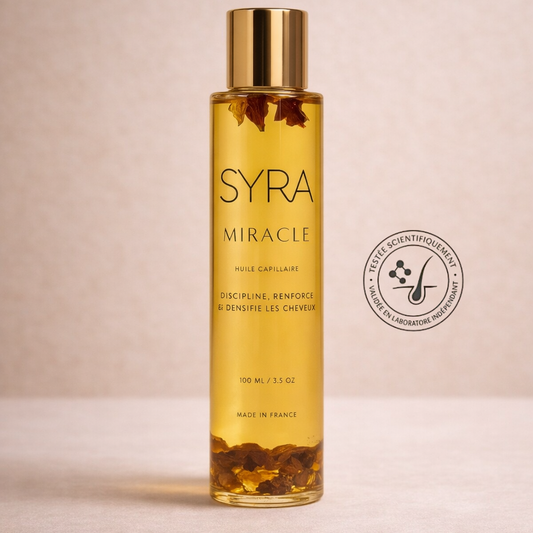
Mix 3 spoons of powder with about 6 spoons of warm water until you get a paste, then add 1 spoon of Miracle Oil to make it even more nourishing. Apply to the scalp and lengths, leave on for 20 to 30 minutes, then rinse and shampoo. During the application, the paste dries a bit on the hair, which is completely normal.
In summary
Amla, or Indian gooseberry, is a small fruit used for generations in Indian hair care. Traditionally, it is used to strengthen the fiber, revive shine, and purify the scalp. It is mainly used as a powder in a mask, left on for about twenty minutes, or as amla oil to massage the scalp. Once a week is a good pace, and amla gives its best when combined with gentler plants and a little oil.
Frequently Asked Questions
Is amla suitable for all hair types?
Yes, amla can be used on all hair types: straight, wavy, curly, or coily. On dry hair, it is better to combine it with gentle plants and a little oil, as in a complete mask.
Can you put amla on colored hair?
Generally yes, amla alone does not color. If you have recently colored your hair, first do a test on a small hidden strand to check that the reflection suits you.
Should you shampoo after an amla mask?
Yes. First rinse thoroughly with water to remove the powder, then do your usual shampoo. Your hair will be clean and free of residue.
How long to leave an amla mask on?
About twenty minutes, and 30 minutes maximum. Beyond that, the paste becomes difficult to rinse without bringing anything more.
What is the difference between amla powder and amla oil?
The powder is mixed with warm water to make a mask, which is rinsed before shampooing. Amla oil is a vegetable oil, often coconut, in which the dried fruit has been macerated. It is mainly used to massage the scalp, in the spirit of an oil bath.
How long does it take to see results with amla?
Shine and touch often change from the first mask. For a real change, allow at least one month of regular masks. We detail the steps in our article amla powder, before and after.
Can you mix amla with an oil?
Yes, it is even recommended, especially on dry hair. Add a spoon of oil to the paste, or do your oil bath first and apply the mask on top.
If you want to enjoy the benefits of amla without having to create your own mixture, the Ayurvedic Ritual Mask brings together amla and six complementary plants for you in a single sachet. Just add warm water and a spoon of Miracle Oil to enjoy a real moment of care every week, as has always been done in India.