Fenugreek for hair: how to use it and what are its benefits?
To enjoy the benefits of fenugreek for your hair, you can soak its seeds to make a gel, mix its powder into a mask, or choose an oil that already contains it. The easiest option to stick with over time is oil, applied as an oil treatment once or twice a week. If you searched for “fenugreek for hair” in your search bar, here is everything you need to know to use it without making things complicated.
Contents
- What is fenugreek?
- Fenugreek for hair: what are its traditional benefits?
- How to use fenugreek on your hair?
- Why we added fenugreek to the Miracle Oil
- What mistakes to avoid with fenugreek
- In summary
- Frequently asked questions
What is fenugreek?
Fenugreek is a small plant in the legume family. Its seeds are most commonly used. Small, hard, and beautifully golden, they have a very distinctive warm, slightly sweet aroma reminiscent of curry or maple syrup.
In India, it is called methi. In the Maghreb and the Middle East, it is known as helba. In these regions, it has been used for generations in cooking, as well as in beauty rituals passed down from mothers to their daughters. Women use it as a paste, as soaking water, or infused in oil, often before washing their hair.
Fenugreek for hair: what are its traditional benefits?
If fenugreek has retained such a prominent place in hair care routines, it is mainly because of the sensation it leaves on the hair. Traditionally, it is used to nourish the scalp, add softness and shine, and make weakened hair easier to style.
Why does fenugreek become slippery in water?
When the seeds are left to soak, they swell and release mucilage, a kind of slightly viscous natural gel. This gel coats the hair fiber and provides the slippery effect that many people seek to make detangling easier. The seeds also naturally contain proteins, which explains why they have long been associated with fine or damaged hair.
Is fenugreek suitable for all hair types?
Yes, it is used on all hair types, from straight and fine hair to curly, coily, and kinky hair. The main difference is the form. Hair that lacks moisture often benefits from seed gel, while fine hair prefers a light oil that won't weigh it down. As with any plant, do a small patch test on your skin before using it for the first time.
How to use fenugreek on your hair?
There are three main ways to use it. None is better than the others; the best one is the one you can stick with for several weeks.
Soaked seeds for a homemade gel
Soak two tablespoons of seeds in a bowl of water overnight. The next day, heat the mixture for a few minutes over low heat, let it cool slightly, then strain it through a fine cloth or a clean pair of tights. You will have a gel to apply to wet hair before shampooing, leaving on for about thirty minutes. This method requires a little preparation, and the gel only keeps for two or three days in the refrigerator.
Powder in a mask
Fenugreek powder can be mixed with warm water to form a paste, either on its own or with other plants. It has the advantage of being quick to prepare. Just remember to rinse thoroughly, as the small particles can get trapped in the hair. If you are new to using powders, our guide to Ayurvedic powders explains how to achieve the right texture.
In a hair oil
This is the most convenient method. Fenugreek is already combined with oil, so there is nothing to prepare or strain, and you can use it as an oil treatment before shampooing. It is also the easiest form to use regularly, and consistency is what makes the difference with natural hair care.
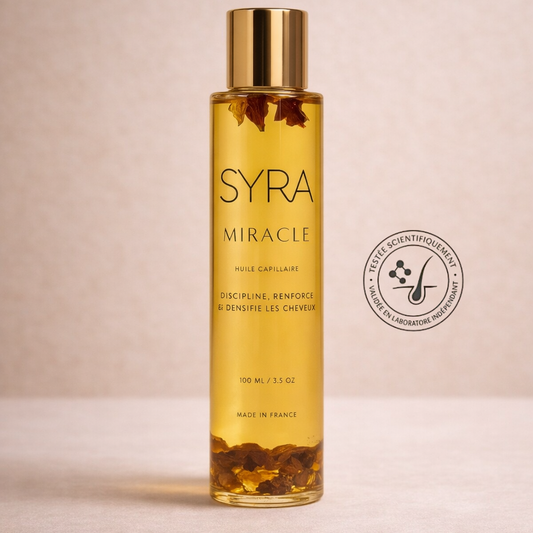
Why we added fenugreek to the Miracle Oil
When Saira created the Miracle Oil, she wanted to capture her family's beauty rituals in a single, easy-to-use bottle. Fenugreek powder is combined with Damask rose, Damask rose, and eight plant oils: sweet mustard, sweet almond, olive, coconut, castor, pistachio, prickly pear, and neem.
Miracle Oil adds density to the hair, promotes length, and strengthens fine and weakened hair. It nourishes the scalp and hair fiber, adds shine and softness, and helps tame frizz. Its texture remains light, does not weigh the hair down, and leaves hair soft and silky after shampooing.
We conducted clinical tests. An independent laboratory monitored 20 volunteers with fine or weakened hair for 12 weeks. Measurements taken on 10 of them showed a 12% increase in hair density and an 8% increase in hair thickness.
How to apply it to get the best results?
On dry hair, divide your hair into four sections. For each section, take a palmful of oil, rub your hands together to warm it, then apply it everywhere, massaging it into the scalp and working it through the lengths. Leave it on overnight, for a minimum of 4 hours and a maximum of 24 hours, then shampoo. All the steps are detailed in our oil treatment guide.
What mistakes to avoid with fenugreek
The first mistake is giving up too soon. Fenugreek does not work all at once; it is part of a routine. An oil treatment once a week for three months is better than a very elaborate mask used only once.
The second is not rinsing thoroughly. Poorly strained gel or powder that is not rinsed well leaves residue and sometimes a slight odor. A good shampoo, or even two if your hair is thick, will solve the problem.
Finally, there is no need to leave fenugreek on your head for days. With an oil, leaving it on for more than 24 hours will not yield any additional benefits. One night is more than enough.
In summary
Fenugreek is a small plant in the legume family that has been used for generations in India, the Maghreb, and the Middle East in hair care. Soaked seeds release a slippery natural gel that adds softness and makes detangling easier. You can use it as a homemade gel, as powder in a mask, or in a hair oil. The easiest form to stick with over time is oil, used as an oil treatment once or twice a week, left on overnight before shampooing.
Frequently asked questions
Does fenugreek leave an odor on the hair?
Pure seeds have a strong odor that can linger slightly on the hair, especially with a homemade gel or paste. Miracle Oil, however, has no odor.
Can fenugreek be combined with a plant-based mask?
Yes. You can do your oil treatment, then apply the Ritual Mask over it before shampooing. You can also add a tablespoon of Miracle Oil directly to the mask paste.
How long does it take to see results?
With Miracle Oil used twice a week, the first results generally appear after one to one and a half months. Once a week also works, just more slowly.
How long should fenugreek gel be left on the hair?
Thirty minutes is enough on wet hair before shampooing. The gel only keeps for two or three days in the refrigerator, so prepare a small amount at a time.
Is fenugreek suitable for curly and coily hair?
Yes. Curly, coily, and kinky hair often benefits from seed gel, which helps with detangling. As an oil treatment, it also works very well on this type of hair, section by section.
Can fenugreek be used on fine hair?
Yes. For fine hair, a light oil containing fenugreek is often more pleasant than a gel or paste. Use the right amount and always finish with a shampoo. Our article on oil for fine hair explains how to avoid weighing it down.
Should you do a test before using fenugreek?
Yes, as with any plant. Place a small amount of your preparation in the crook of your elbow and wait 48 hours before using it on your scalp for the first time.
Fenugreek is one of those simple plants that is a pleasure to rediscover, provided you use it regularly. If you want to enjoy its benefits without preparing a gel or straining seeds, Miracle Oil combines fenugreek, Damask rose, and eight plant oils in a ritual that is easy to stick with, week after week.